Rust Cheats Explained, Menu, ESP and Aimbot
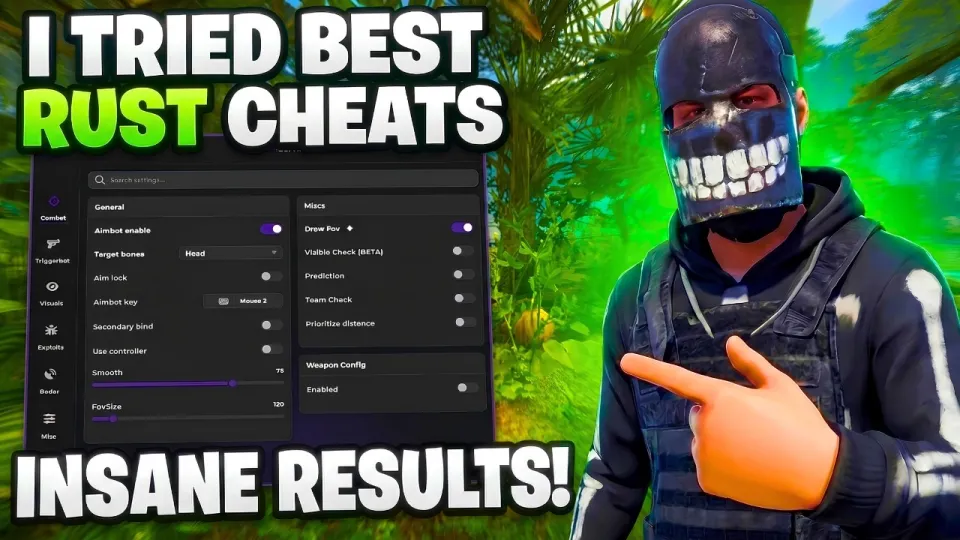
Video: I Secretly Used Rust Cheat To Dominate Everyone In The Server...(INSANE)
· based on the channel yqzkqrv
Rust cheats are third-party software tools that add information overlays and automated aiming to the survival game Rust, and they are typically sold as private, subscription-based packages with an in-game menu. One of the products marketed this way is the Zaliant Private Rust Cheat, which a showcase video from the channel yqzkqrv walks through from menu to gameplay.
What a Rust cheat menu actually contains
A modern Rust cheat is not a single toggle but a menu with several independent modules, and the showcase format used in the yqzkqrv video follows the standard layout: an intro with the menu open, a features overview, then gameplay footage. The core modules in packages of this type are:
- ESP / wallhack — outlines and labels drawn through walls for players, sleeping bodies, loot crates, airdrops, vehicles and tool cupboards, often with distance readouts and health or team indicators.
- Aimbot — automatic target selection with adjustable field of view, smoothing, humanization and hitbox priority (head, chest, nearest bone).
- Miscellaneous — no-recoil or reduced spread, fast crafting, instant loot transfer, silent actions and similar conveniences.
- Visual and interface settings — color pickers, font sizes, keybinds for opening the menu, and config saving so a profile can be reloaded between sessions.
Because Rust's combat is built around projectile travel time and recoil patterns, the aimbot module is the part that matters most in practice, while ESP is what changes how a player reads the map.
How private Rust cheats are sold and delivered
Private cheats are distributed differently from the free loaders that circulate on forums. A purchase usually goes through the vendor's own store, as with the Zaliant store linked from the video, and the license is tied to a hardware ID rather than an account. That means:
- Subscription pricing — access is sold per month, with longer terms discounted; there is no permanent one-time license in most cases.
- HWID binding — the loader registers your machine, and moving to a new PC requires a reset, often paid or limited.
- Loader-based updates — the cheat is injected through a separate loader that must be updated after Rust patches, so downtime after a forced wipe is normal.
- Discord support — vendors run a Discord server for setup help, status announcements and key replacement, which is the practical channel when something breaks.
Prices for private Rust packages generally sit in the range of a mid-tier game purchase per month, which is why most buyers treat them as a short-term experiment rather than a long-term tool.
Ban risk and Easy Anti-Cheat
Rust uses Easy Anti-Cheat, and that single fact defines the risk profile of every cheat on the market. Anti-cheat works on several layers: signature detection of known binaries, behavioural heuristics that flag impossible aim curves or information the client should not have, and manual review of reported players, including footage submitted by other users.
What this means in practice:
- No cheat is permanently undetected. Vendors update loaders after detection waves, but a ban can land weeks after the last session, and Rust bans are applied to the account and often the hardware.
- Behaviour matters more than the menu. An aimbot with high FOV and no smoothing generates statistics that are trivially visible in server logs; the settings shown in showcase videos are chosen for demonstration, not for longevity.
- Server owners can act independently. Community servers run their own plugins and admins, so even a client that survives anti-cheat can be removed by a moderator watching replays.
- Account value is the real cost. A Steam account with years of Rust skins and hours is worth far more than a monthly subscription, and a game ban is visible on the profile permanently.
Reading a cheat showcase critically
Showcase videos are marketing material, and the yqzkqrv breakdown of the Zaliant Private Rust Cheat follows the genre's conventions: a short intro with the menu, a quick features pass, then a gameplay segment framed as a final review. When evaluating any such video, several things are worth separating:
- Demonstration versus stability. A two-minute gameplay clip shows what the software can do once, not how it behaves across a 200-population server, a raid defence or a long wipe.
- Feature lists versus usable settings. A menu with forty toggles is not better than one with ten that work; the interesting details are the smoothing values, the FOV limits and whether the ESP updates correctly at distance.
- Footage provenance. Clips are recorded by the vendor or an affiliate, and the servers shown are often low-population or private test environments where nothing is at stake.
- Review framing. A "final review" inside a video that links to the product's checkout page is a sales segment, so treat the verdict accordingly.
Practical alternatives to buying a cheat
For players who want the same informational advantage without the ban risk, Rust itself offers legitimate routes. Rust+ and the in-game map give team positions and monument layouts, and community servers frequently run kits, teleport or PvE modes that remove the grind that pushes people toward cheats. Aim training in dedicated servers and offline recoil practice on the training grounds improve the skills that an aimbot replaces, and they carry no risk to the account.
On the server side, admins who suspect cheating can check player reports, review combat logs and use anti-cheat plugins alongside Easy Anti-Cheat; most large community servers publish their ban lists publicly, which is a useful reality check on how often bans actually happen.
All links from the video
- Zaliant Private Rust Cheat product page: https://www.zaliantservices.com/products/rustprivate
- Zaliant store front page: https://www.zaliantservices.com
- Zaliant Discord community: https://discord.gg/zaliant
Bottom line on Rust cheats
Rust cheats such as the Zaliant Private package shown by yqzkqrv combine ESP, aimbot and utility modules behind a subscription license bound to your hardware, and they operate against Easy Anti-Cheat with no guarantee of survival. The menu and gameplay footage in the breakdown are a useful illustration of what these tools look like in 2026, but the economics are unchanged: a monthly fee against the permanent loss of an account and its skins. Anyone curious about the product can check the Zaliant Private Rust Cheat page and the vendor's Discord for current status before spending anything, and should assume a ban is a question of when rather than if.
Key takeaways
- Private Rust cheat packages are sold through dedicated stores such as zaliantservices.com, with the Rust Private product listed at /products/rustprivate.
- Typical Rust cheat menus combine ESP (player, loot and container outlines), aimbot with configurable smoothing and FOV, and miscellaneous options like no-recoil or fast crafting.
- Rust runs Easy Anti-Cheat, so every third-party cheat carries a ban risk regardless of how the menu is advertised.
- A cheat showcase video from channel yqzkqrv covers the Zaliant Private Rust Cheat menu, its settings and in-game footage.
- Private cheats are usually priced as monthly subscriptions rather than one-time purchases, and licenses are tied to a hardware ID.
Source: I Secretly Used Rust Cheat To Dominate Everyone In The Server...(INSANE) · Markdown version
Questions & answers
What features does a typical Rust cheat include?
Most private Rust cheats bundle ESP for players, loot and containers, an aimbot with adjustable FOV and smoothing, and utility options such as no-recoil or fast looting. The menu usually adds keybinds, color settings and saved configs so profiles can be reloaded between sessions.
Are Rust cheats undetected?
No. Rust runs Easy Anti-Cheat, which combines signature detection, behavioural heuristics and manual review of reported players. Vendors update their loaders after detection waves, but bans can arrive weeks later and are applied to the account and often the hardware.
How much do private Rust cheats cost?
Private packages are sold as monthly subscriptions through vendor stores, with longer terms discounted, rather than as one-time purchases. Licenses are tied to a hardware ID, so moving to a new PC usually requires a paid or limited reset.
What happens if you get caught cheating in Rust?
A game ban is applied to the Steam account and is shown publicly on the profile, and Rust bans frequently extend to the hardware. Skins and hours invested in the account are lost, and community servers can also remove players through their own admin and plugin systems.